
Why Am I Drowning in RFIs? When Contractors Don’t Read the Drawings
Why Am I Drowning in RFIs? When Contractors Don’t Read the Drawings
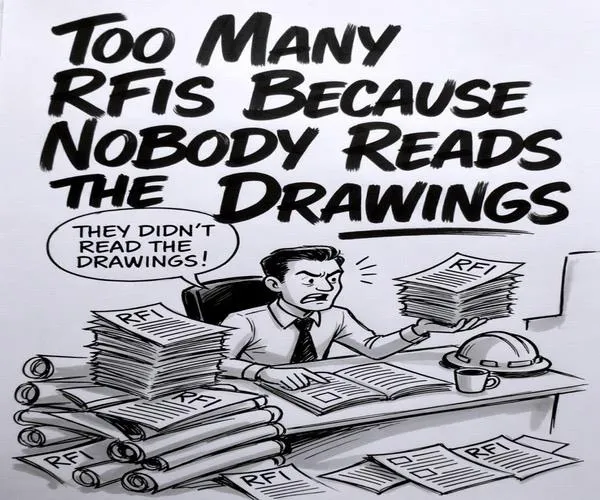
As a Construction Administrator and Project Coordinator working with architects in Southwest Florida, I’ve seen my fair share of project challenges. But nothing tests your patience quite like opening your inbox to dozens of Requests for Information (RFIs) that could have been answered by simply opening the construction drawings.
If you’re an architect, CA, or project coordinator dealing with the same issue, you’re not alone. Today I’m sharing why this happens, the real cost to projects, and practical ways to reduce unnecessary RFIs.
What’s an RFI (and Why Do They Matter)?
An RFI is a formal process where the contractor, subcontractor, or supplier asks for clarification on the contract documents—drawings, specifications, or other requirements. On paper, RFIs are a healthy part of construction. They help resolve ambiguities and keep everyone aligned.
The problem? Many RFIs aren’t about genuine gaps in the documents. They’re about things that are clearly shown or noted—if only someone had read them.
The Real Reason Behind the RFI Flood
In my experience, the top culprit is straightforward: contractors (or their teams) aren’t thoroughly reading the drawings.
Common scenarios I encounter:
•Dimensional conflicts or missing details that are actually coordinated on Sheet A-xx or the structural plans.
•Material specifications buried in the specs that get ignored in favor of “what we usually use.”
•Coordination issues between disciplines that are resolved in the general notes or enlarged details.
•Field conditions questions that reference existing conditions shown on the demolition or survey sheets.
Why does this happen so often?
•Tight schedules and thin staffing push teams to “get moving” before fully reviewing documents.
•High turnover or less experienced field personnel.
•Assumption that “it’s probably like the last job.”
•Poor communication between the estimator who bid the job and the superintendent running it.
Whatever the cause, the result is the same: unnecessary back-and-forth that slows down the project.
The Hidden Costs of Excessive RFIs
Each unnecessary RFI carries real consequences:
•Time delays — Reviewing, responding, and distributing answers takes days or weeks.
•Administrative burden — Architects and CAs spend hours on clarifications instead of higher-value work.
•Cost overruns — Change orders often follow poorly handled RFIs.
•Relationship strain — Constant RFIs create frustration on all sides and erode trust.
On one recent project, we received over 40 RFIs in the first month that directly referenced information already provided in the drawings. That’s time and money no one can afford.
How Architects and CAs Can Reduce RFIs
While we can’t control the contractor’s internal processes, we can set projects up for success:
1.Clear, concise documents — Use consistent organization, bold key notes, and cross-referencing.
2.Pre-construction review meetings — Walk through the drawings together and highlight critical coordination areas.
3.RFI tracking system — Use project management software (Procore, PlanGrid, etc.) to spot trends early.
4.Timely, thorough responses — Provide sketches or marked-up drawings when verbal clarification isn’t enough.
5.Post -RFI lessons learned — At the end of the project, review common RFIs and improve the next set of documents.
Advice for Contractors: Read Before You RFI
If you’re on the contractor side, here’s a simple rule that will save everyone time and money:
“Read the drawings twice before issuing an RFI.”
•Train your team on how to efficiently navigate a full set of documents.
•Create internal checklists for common items (dimensions, materials, coordination points).
•Have estimators and superintendents review documents together during handoff.
•When in doubt, call the CA first for a quick informal clarification before formalizing an RFI.
Respecting the documents builds credibility and speeds up the entire project.
Final Thoughts
Excessive RFIs driven by unread drawings aren’t inevitable—they’re a symptom of communication breakdowns and process gaps. By addressing the root cause, we can deliver smoother projects, stronger teams, and better outcomes for owners.
If you’re an architect or CA struggling with RFI overload, I’d love to hear your experiences in the comments. What’s the craziest RFI you’ve ever received that was already in the drawings?